
NRC Proposal for New Steelhead Limits Part 2
Current Status of Fisheries Order 200.22
The Natural Resource Commission convened the November 10th meeting by tabling the New Steelhead Limits for further discussion (Steelhead Proposal). Fisheries Order 200.22 will be back on the table and up for a vote at the December 9th meeting. There are a couple of probable outcomes for the Commissioner Nyberg Amendment at the upcoming December meeting. The NRC will either put the amendment to a vote or table Fisheries Order 200.22 for the upcoming 2022 agenda. If the Nyberg amendment is brought to a vote and passes then enforcement will begin on March 15, 2022.
There is still time to have your voice heard! We encourage everyone who enjoys fishing for Steelhead in Michigan to submit their own opinion. A reduction in Steelhead Bag Limits may or may not have a positive impact on Michigan Steelhead populations. However, it’s safe to say that a Bag Limit reduction will not contribute to further population declines (See Graph on our other post). Please take a moment and write a letter regarding the amendment to Fisheries Order 200.22. Time is short so submissions should be sent without hesitation before the December 9th meeting. NRC@michigan.gov
Summarizing the November 10 NRC Meeting
During the last NRC meeting, MDNR Fisheries Division presented their data and recommendations to the NRC. According to the MDNR Fish Division there is NO need for immediate action to maintain current Steelhead Populations. The Biologists admitted there is a current decline in Steelhead numbers and suggested the major problem primarily exists in Lake Michigan. The leading limiting factors addressed throughout the presentation were increasing water clarity, out migrating smolt predation, and low survival rates of hatchery Steelhead.
The second recommendation from MDNR presenters was they are NOT in support of reducing Steelhead Bag Limits. The consensus “Belief” among MDNR Fish Biologists is the New Steelhead Limits will not increase Steelhead Populations. This assumption may be true, however, a reduction in Steelhead Harvest will not cause any further decline in Steelhead numbers. The presentation fails to present any relative data that reducing Steelhead Bag Limits will not benefit the declining Steelhead Population.
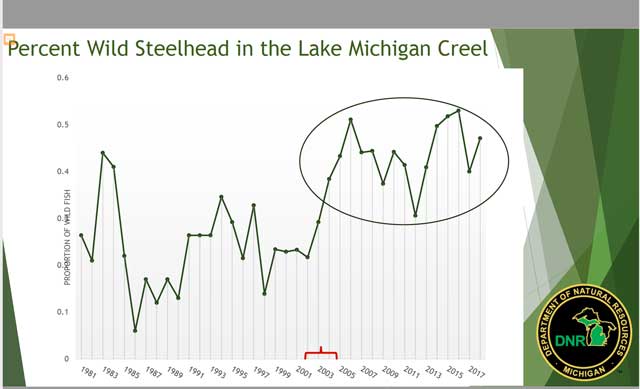
The presentation includes one slide shown here showing the Percent of Wild Steelhead Harvested in Lake Michigan. There has been a significant increase in the proportion of Wild Steelhead Harvest from Lake Michigan since 2003. Since 2013 the proportion of Wild Steelhead Harvest in Lake Michigan is the largest recorded since 1983. This chart follows the current observations from Guides and Anglers regarding Clipped and Unclipped Steelhead in our catch. At some point Harvest will negatively impact Steelhead populations and current trends suggest that we may already be at this point.
Smolt Production
Another argument repeatedly addressed in the echo chamber against the Nyberg Amendment pertains to Smolt production. MDNR Fish Biologists “believe” there are still enough returning Adult Steelhead spawning every year. The primary assertion is Adult Steelhead are successfully saturating the habitat with juveniles despite lower population densities. This assumption may be true, but there are some flawed claims to note with this line of thinking.
It is possible that fewer adults can successfully maximize their spawning efforts during good conditions. The underlying concern here is what happens when you have multiple years of poor conditions impacting smolt recruitment. In low population densities there is a greater probability of poor recruitment. If smolt abundance consistently falls below a desired threshold, the inherent future risk is further population declines.
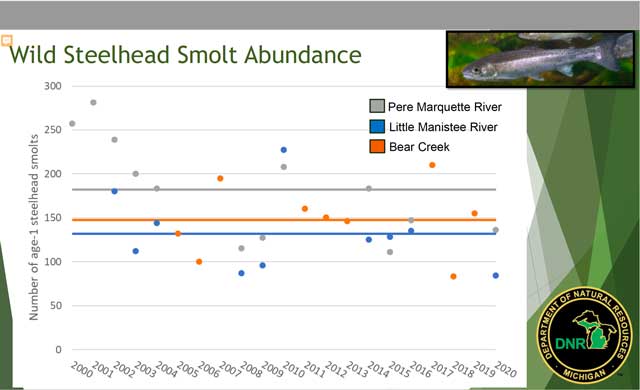
The MDNR presentation includes data for wild Steelhead Smolt Abundance. This slide was an attempt to demonstrate support for their assumption regarding Smolt recruitment. Interestingly the data is only presented from the years 2000 to 2020 when Steelhead populations were already in decline. What about the 25 years of prior data? Why was this comparison not made? The appearance of the data presented makes it look like Smolt production has remained steady, but has it?
Some important details to note about the methods used during the surveys aimed at assessing Wild Steelhead Smolt Abundance. Surveys are conducted at one location per stream and sampled over a three year period. During the following three years no surveys are performed. In my opinion, the method of the data collection creates too many gaps in their time-series analysis. Albeit useful information, the data should fall under intense scrutiny. The assertion that we have enough Spawning Adults to completely saturate the habitat with juveniles may prove to be a flawed conclusion.
The Final Push
The Great Lakes Steelhead population decline is a multifaceted issue. The decline is comprised of multiple limiting factors. It’s going to take a lot of time, money, and man hours to assess the cumulative impacts affecting our Steelhead populations. Current Guide reporting for the Manistee River Catch Reports shows preliminary estimates of 98% unclipped fish (as of 12/1/2021). The hatchery component is almost entirely missing and harvest on the Manistee is almost entirely comprised of unclipped fish. The Biological issues associated with the Great Lakes are currently out of our control. However, limiting harvest is an immediate response we can utilize to avoid further decline in Steelhead populations.
The truth of the situation is we have fewer fish to fish for. In other words we have a fish catching problem! Catch rates have been declining for some time and they are not getting any better. The current fishery doesn’t produce enough fish to keep angler satisfaction high and ultimately license sales and angler participation will suffer due to the current lack of opportunity. Right now we need to balance steelhead catch rates and harvest in order to increase angler satisfaction. It’s time to share the resource, recycle fish, and practice more catch and release with reduced harvest limits in place.
Make Your Voice Heard
The time for talk is over! There is a need to move on a short term solution to allow this conversation to continue. Now is the time to hit the pause button on harvest as we are quickly approaching the 2022 Spring Steelhead run. MDNR Fish Division was not able to operate the Little Manistee Weir in 2020 due to Covid-19. Unfortunately no Egg Take occurred and subsequently no Steelhead plants happened in 2021. New Steelhead Limits are the only effective tool we currently have at our disposal.
Limiting harvest will provide a short term net zero impact on declining Steelhead populations. Passing the Nyberg Amendment and limiting the harvest of Spring Steelhead in 2022 can only positively impact future returns of Steelhead. Unfortunately the MDNR is not advocating this position and your opinion on this issue matters now more than ever. If you enjoy catching Steelhead in the Great Lakes then make your voice heard regarding the New Steelhead Limits! NRC@michigan.gov