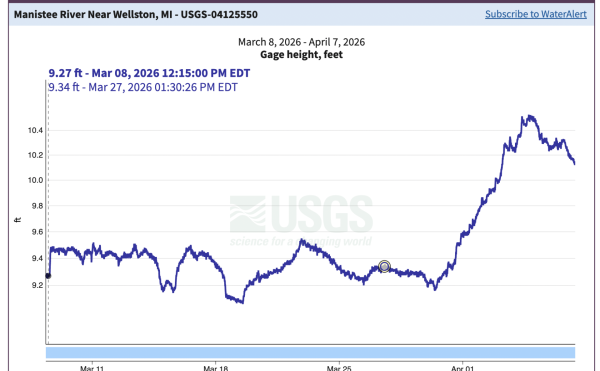
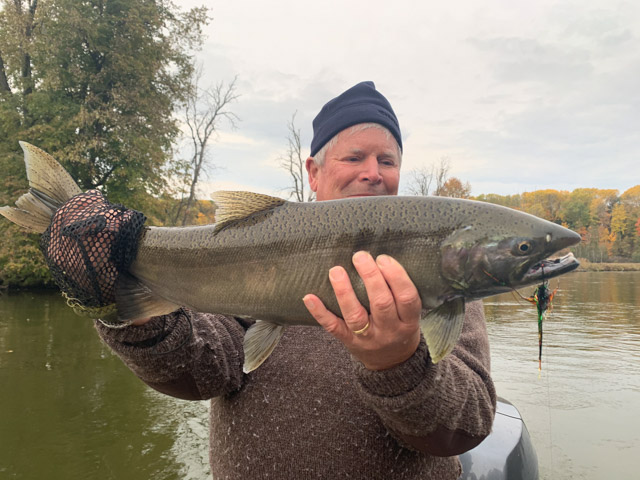
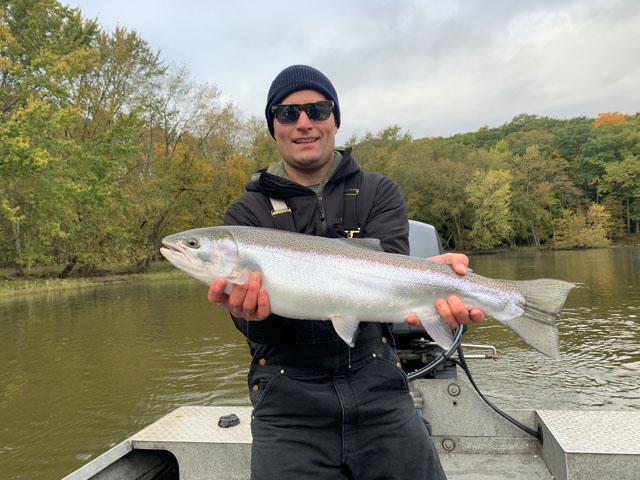
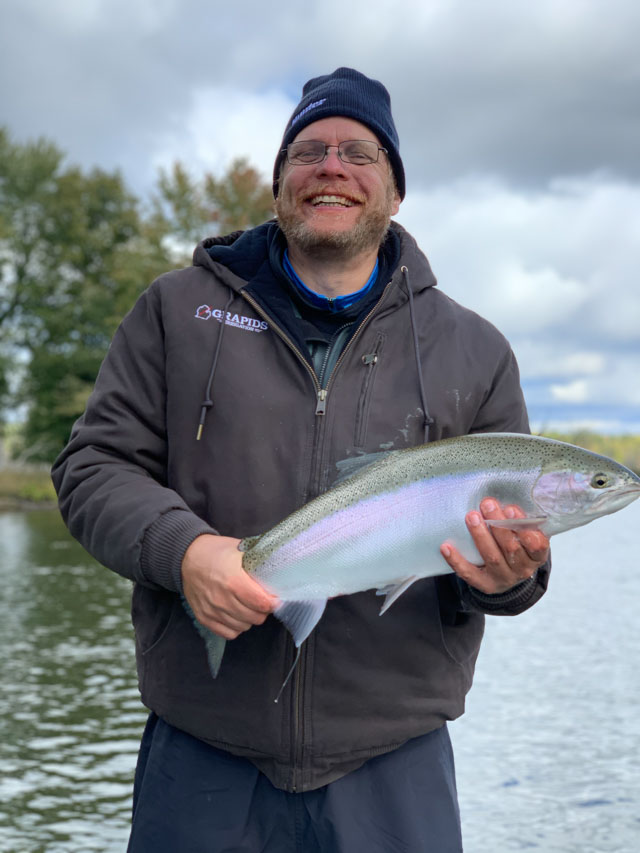
Spring Steelhead Report below Tippy Dam water levels remain high but are slowly dropping. However, the Pine River upstream of Tippy Dam is dumping a heavy mud stain into the Manistee, creating very low visibility and poor clarity. As of today, flows are 4,360 cfs and the water temperature is 41.4°F.
All of our guide trips have been canceled or rescheduled since last week’s big rain events, but it’s looking like we’ll be able to get back out there very soon. High water is a common spring issue—especially after a heavy snow year—so we knew this was bound to happen at some point during the spring steelhead season.
The good news: conditions should improve shortly as flows continue to drop and the river clears. With water temps just getting into the 40s, we’re approaching the peak window and things should be firing again soon.
We will have a new update coming soon once we can get back on the Manistee River.
Booking a Trip
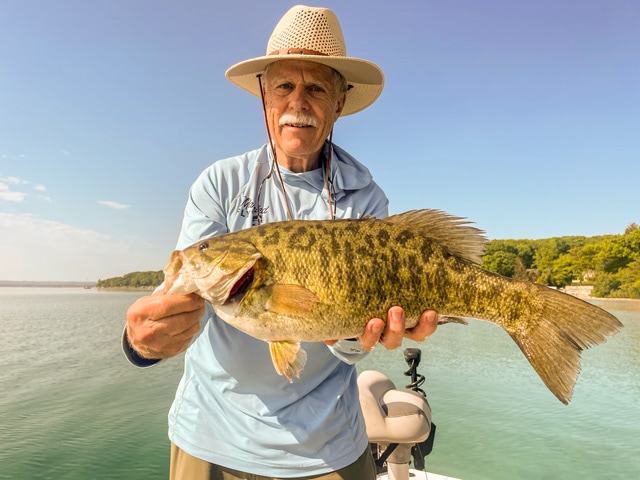
The Manistee River below Tippy Dam is one of the best west side rivers in the state of Michigan. We specialize in Steelhead and Trout fishing on this section of the Manistee River Watershed. Now is a great time to book your Spring Fishing adventure as well, with Steelhead, Trout, and Pre-Spawn Smallmouth on the agenda.
If catching a Great Lakes Steelhead in on your wish list give us a call to join in the fun at (231-631-5701), you can also shoot us an email. We are currently booking Spring Steelhead, Pre-Spawn Smallmouth Bass, and a few remain peak Trout Dates for Michigan Dry Fly Fishing.
Jon Ray
https://mangledfly.com/wp-content/uploads/2026/03/Screenshot-2026-04-07-at-8.56.53-AM.png11881920Jon Rayhttps://mangledfly.com/wp-content/uploads/2023/04/mangled-fly-northern-michigan-300x181.pngJon Ray2026-04-07 02:03:002026-04-07 13:11:26Manistee River Steelhead Report below Tippy Dam
What a crazy week of weather. It seems like Mother Nature needed to get it all out of her system—hopefully she did.
On the bright side, the cold temperatures and the snow/ice storm should slow the spawn down and extend our steelhead season. Water temps dropped from the mid-40s to the mid-30s last week. River levels rose with the rain ahead of the snow and ice, and then—did we ever get snow and ice. With frozen ground and colder temps, the river is now dropping slowly. As levels continue to fall and water temperatures gradually creep back up, the next couple of weeks should fish well. With a mix of winter holdover fish and a slow trickle of spring-run steelhead, this could shape up to be a great spring steelhead season.
Our go-to method for targeting steelhead this time of year is float fishing. With water temps still in the winter range, steelhead are holding in softer, slower water, and the float is the best way to cover those lanes effectively. Beads have been the top producer. With the water high and dirty, 10mm–14mm beads in bright colors have been working well. That will change as the river warms, but it’ll be a bit before we see a real shift. There’s not much insect activity yet—we’re still waiting on that first spring stonefly to signal that spring is truly here.
Brown Trout
Brown trout fishing has been hit-or-miss. Between the weather and the stained water, trout have been tucked into some hard-to-reach spots—especially log jams. If your timing is right and they’re willing to bite, you can do well. Most trout have been eating beads. Nymphs haven’t been very consistent, though we’ve had the occasional fish chase a streamer. Minnow patterns have also been getting a few looks.
The river is high and stained, so if you’re walking and wading, please be careful. Over the last few days we’ve also seen some new logs show up in the river, which could make wading more challenging than usual.
We still have a few open spring dates available—if you want to float the PM, let us know!
Top picks for steelhead hooks, talk about a sticky topic! I’m sure this is going to open a can of worms, but I wanted to address this topic as it gets a lot of attention amongst our guide staff. Every day, no matter what we are fishing, every rig we tie starts with a hook. It doesn’t matter if we are tying up a batch of streamers for steelhead, or if we are twisting up a bead rig for Alaska or Northern Michigan. The hook is usually the first item we start with.
Hook choices have consequences! Personally, I know I will never run a B10S hook again for trout. I’m fine using it for smallmouth bass, but I don’t have a scientific reason for it. Basically it’s the same reasoning I use when putting my right sock on first followed by my left. The same holds true with our favorite hooks for steelhead. It’s not really about scientific findings, but more about having confidence.
In order to shed some light on choosing the best hooks for steelhead, I have included a list of hooks preferred by Mangle Fly Guides below. This list of hooks has been proven over time and is Guide approved. For the purpose of this discussion, we chose hooks you can use for both swing and egg fly presentations. My hope is this list will help you decide which hooks to use this winter to prep your spring steelhead box.
Streamer Hooks
Streamer fishing for steelhead is not easy and you typically must capitalize upon fewer opportunities. You need a hook that is strong enough to land the Big Boyz, but light enough for your fly to move properly. The following is a Guide recommended list of streamer hooks for steelhead.
Owner Mosquito – is our number one choice for steelhead swing flies. This hook is a top choice personally and for Ed McCoy and Steve Pels as well. Most importantly, this hook has proven to be strong enough to handle the biggest Manistee River steelhead. Another advantage with this hook is the light wire, allowing me to pull a high percentage of my flies back from the log jams on 16# fluorocarbon. I like this hook in size 1 for most of my steelhead streamer patterns.
Gamakatsu Finesse Wide Gap – this is another one of Ed McCoy’s go to hooks. Ed runs this hook in size 1/0 and 1. He likes the big gap and very positive hook up ratio on fish that eat the fly from behind. This is a great hook later in the season to capture those fish that are nipping at the tail.
Daiichi 2557 – This hook has a super sticky point and will not bend out on hot fish. It has an oversized eye and makes passing trailer wire through the hook eye very easy. As is the case with most of our swing flies, we use wire or braid to attach the hook to our shanks. Steve likes this hook from size 1 to 4.
Fall Steelhead on the Swing
Streamers for Steelhead
Bonus Streamer Hook
The bonus streamer hook is a “baby treble” and I was scared of what might happen upon hooking up. Baby trebles in size 10 or 8 work really well and more or less pin the steelhead upon contact. This is one of my late season hooks that might ruffle a few feathers. I only run this particular hook when temps are dropping from 40 degrees into the 30’s. I prefer this hook for days when one bite is likely all we will see on the swing. When you’re searching for one bite and only getting lethargic tugs or pulls, this hook can save the day. Try this treble hook on your next cold front fishing trip.
VMC 9650 – I use this hook in size 10 and size 8. It’s super sharp and strong enough to land most steelhead. An added advantage to these light wire hooks is you will get all of your flies back from the many log jams along the Manistee River. Another bonus with this hook is the oversized eye makes passing wire or braid through them a breeze. One point of caution regarding this hook. I would not recommend using these treble hooks in October or during heavy spring run off, it will not hold. If the steelhead is super charged up it will bend them right out. Please understand, when you hook up with this hook you have to take your foot off the gas. You can’t pull as hard as you normally do with the bigger heavy wire swing hooks.
Egg Hooks
The meat and potatoes fishing in the Great Lakes area is with egg patterns. It’s not uncommon for me to fill the tackle box with 1000’s of egg hooks in my preseason orders. Having tried a slew of egg hooks over the years, here is where we stand currently on the best of the best.
Gamakatsu Bead Hook- Gamakatsu released this hook in 2024, we first started playing with it in the fall of 2025. Now by Spring of 2026 it has replaced many of my previous Bead Hooks. I have made an adjustment in my thinking when it comes to Bead hooks. I want the strongest, lightest wire hooks I can find. Without a doubt this hook by Gamakatsu fits the bill. Made from Gamakatsu’s Tournament Grade Wire (TGW), the Bead Hook features a thinner, stronger, and sharper wire that easily penetrates the hard jaw plates of Great Lakes Steelhead and Salmon. Its Nano Alpha Coating offers superior corrosion protection, ensuring the hook’s longevity and also provides a super slick finish for improved penetration. This hook reminds me TWG hook we use for Drop Shoting for Smallmouth Bass.
Raven Specialist– Especially the size 6 option for size 10mm or 8mm sized beads. The benefits of this hook are the smaller diameter gauge metal, along with the micro barb make for better penetration and great hook up ratio. This is the perfect all-purpose hook. It is considered the most dependable Steelhead hook on the market with its great hooking and holding power. One of our favorites when you have to down size during early spring steelhead.
Owner SSW– when it comes to fishing beads and egg patterns, no one on our staff has more experience than Jeff Topp. Having guided in Alaska for over 22 years, when Jeff recommends a hook I listen. For bead fishing he likes the size 4 hook with 10mm beads and the size 6 hook with 6mm to 8mm beads. The number one reason he likes this hook is the wire. This hook has a very strong thin wire making hook penetration better for Alaskan Rainbow Trout and Manistee River Steelhead. This razor sharp hook serves him well from size 6 to size 1 depending upon the bead size he is fishing.
Closing Thoughts
With so many hook options available at your local shops to choose from it can get confusing. I know this is just a sampling of choices, but the idea here is to help you make educated hook selections. Over the last few years we have been tying fewer yarn eggs, but the same hooks we use for fishing beads also work really well when tying big rag style yarn flies. For instance, the red Owner SSW listed above is one of my favorites to tie oversized egg patterns on for Spring Steelhead.
Treble hooks in the fly fishing world are nothing new, but I personally had no experience with them back in the day. Ten plus years ago, when I first ran treble hooks, I was very nervous and pessimistic to be honest. What would happen to the steelhead? How torn up would the mouth of my prized fish become? Would my fly just get tangled up in all the treble hook points? Experience has played a big part in answering some of these concerns. For example, the bigger hooks listed above actually do more damage than the VMC treble hooks.
This current list of hook choices is what we prefer for most of our fishing situations. I’m sure over time I will edit this list as new hooks are forged and some of the old standby’s are no longer available. Please feel free to add your favorite hooks in the comment section below and thanks again for checking out the blog.
I can still remember the day when the light bulb turned on and I finally understood the need to change my float to match the water type I was fishing. Changing floats based on water type isn’t something you hear much about. Actually it’s a simple change that can make a big difference, especially in the spring, when steelhead themselves are changing the water types they utilize.
Fishing Story
Let’s start with a real world scenario, or as I like to commonly refer to it, my lightbulb moment. It was December and I just spent the past 60 days fishing for steelhead on the lower Manistee River, the section closest to Lake Michigan. Most of those days were spent primarily fishing floats in the lower end of the river. I had my confidence rig all setup and ready to go and for whatever reason I decided to change it up and shift the guide trip towards Tippy Dam.
https://mangledfly.com/wp-content/uploads/2020/02/float-fishing-steelhead-355.jpg427640Jon Rayhttps://mangledfly.com/wp-content/uploads/2023/04/mangled-fly-northern-michigan-300x181.pngJon Ray2022-02-23 10:50:582023-09-21 12:58:10Changing Floats based on Water Type
There is a new proposal up for consideration by the NRC that would reduce Steelhead bag limits on several sections/streams in Michigan. Here is the NRC Proposal New Steelhead Limits being considered by the NRC. The current steelhead management plan for Michigan needs to be revised to reflect current trends, conditions, and annual adult spawning migrations. We are not opposed to people having the opportunity to harvest a fish even though we practice catch and release. This request for change has nothing to do with gear restrictions and by no means should we dictate how people can legally fish for steelhead. Steelhead populations are in decline and have been on the long slide for over the past decade. Which raises several questions and highlights a need to address and discuss the future of Steelhead management in our state.
Data gaps and changing environmental conditions have muddied the waters, but indicators are everywhere. Anyone that has spent any amount of time on the water can see the changes that have occurred. Which poses several questions. What is the current status of spawning steelhead in our streams? Does the current management scheme reflect what anglers are currently experiencing in their catch rates? Can a declining steelhead population survive added angling pressure with todays current harvest allowance? The MDNR has admitted there is a problem, but currently there has been a failure to act even though there are plenty of red flags.
Little Manistee River
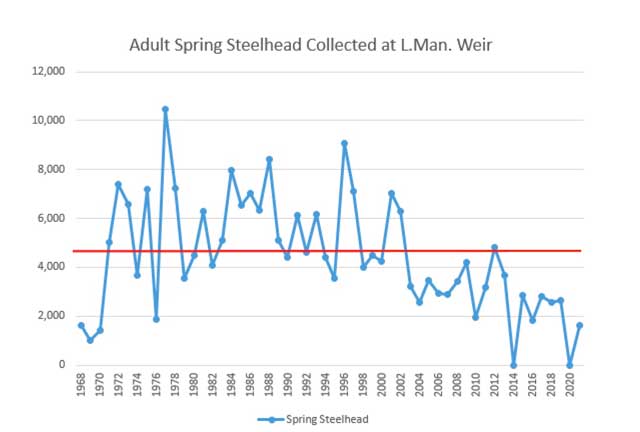
The Little Manistee River Weir boasts the best available data for returning spring Steelhead. This little river is the sister river to the Big Manistee. Albeit smaller in size, it can still shed light on the current trend of Steelhead returns in the Big Manistee River. Since 2002 there has been a significant reduction in Spring Steelhead in the Little Manistee River. The 6 year average from 2009-2014 was 3,433 returning adults and from 2015 to present it was 2,389 returning adults (excludes 2020). In the last 6 years there has been a 30% reduction in average spawning adults. If this trend continues, then what? The spring 2021 returns were the lowest since 1970. More importantly, every year since 2003, the spring steelhead counts have been below the 53 year average of 4,648 adults.
Are we just going to standby and watch our Steelhead populations decline to a point of no return? It’s not far fetched to consider the outcome of 10 more years of decline. The consequences could ultimately exceed the ability of the population to recover. There is a COST TO NO ACTION! Steelhead catch rates are declining statewide as well. Right now this state has a Steelhead catching issue. The proposed rule changes will probably not boost the overall population size, but a declining Steelhead population will not promote productive fishing. This proposal is a good start to a long overdue conversation. Catch Rates, Harvest, and Angler Satisfaction are currently out of balance. We can’t afford to wait for things to get any worse! Now is the time to have a serious discussion regarding harvest limits. What should our annual harvest look like based upon today’s current steelhead population trend? We need to bring the Harvest and Catch Rates back to the middle and rebalance Angler Satisfaction.
Big Manistee River
The close proximity of the Little Manistee River to the Big Manistee River also raises parallel questions. Is there a similar population trend occurring in the Big Manistee River? What about the rest of the Lake Michigan Basin? Is this trend occurring throughout the Great Lakes Region? We believe it is! How can we continue the “Business as Usual” model? To say there isn’t a biological reason to consider a regulation change is a dangerous claim. Just because you have an inherent lack of data doesn’t excuse you from responding to the problem. Changing the regs is a short term fix that will allow more time for data collection. Fully understanding the complexities surrounding the Steelhead population decline will take time. How long will “the data collection” take, 5-10 years? Can we justify waiting that long without taking action? Is it worth risking this popular fishery? Just a little food for thought.
Email NRC
We encourage everyone to email your own letter to the NRC. This is an important issue and if you enjoy fishing for steelhead you should be paying attention. Acting now may avert loosing something that is more than 100 years in the making. Here is the email for the NRC , please send your public comments to this address before November 10th.
https://mangledfly.com/wp-content/uploads/2019/10/fall-steelhead-northern-michigan296-2.jpg640640Ed McCoyhttps://mangledfly.com/wp-content/uploads/2023/04/mangled-fly-northern-michigan-300x181.pngEd McCoy2021-10-31 10:35:002023-09-21 12:42:46NRC Proposal New Steelhead Limits
Fall steelhead 2019 update. The Manistee River continues to fish pretty well for fall steelhead. The last few days fish numbers have slowed down as we haven’t received a push of fish in a few days, but with a good number of steelhead in the upper sections opportunity still prevails. While pressure remains high with other boats and anglers you have to have a good presentation to get the job done.
The egg bite has been the main tactic but the streamer rods have started to make it into the rotation as well. Craig had a exciting morning yesterday that I want to expand upon in the next blog. Working with a new single hand set up that I want to go into more details about. Craig as seen above in the picture gallery landed a nice Coho on a ESL (egg sucking leech) and wait to you hear about our other encounter. For those interested in the streamer / Swing bite, Steelhead have set up in the runs where we like them. At least I’ve been finding them in that type of water with the egg presentation. So I believe that the time is right to start hunting the fall steelhead run with both eggs and streamers.
Wish everyone the best of luck this fall, more updates coming. Hope to get to the single hand line combo blog this week as well
Here is a link below to the Finished Huron Drifter on their Facebook page, if you followed along in the building process post. A don’t be worried I’ll be taking many more water pics with this craft in the coming months. Happy with how she turned out, thank you Jason and Tracy for all your hard work. Any questions about this boat give Tracy a call, let them know I sent ya, you will be well taken care of.
Late Fall / Early Winter steelhead fishing is off to a great start make sure to check out the Manistee River steelhead report, with strong winds and some much need precipitation this past week steelhead were on the move. Along with the Mansitee River, another great tailwater to fish this time of year is the Muskegon River. Both rivers offer great steelhead fishing the month of December .
https://mangledfly.com/wp-content/uploads/2016/11/Screen-Shot-2016-11-25-at-10.56.02-AM.png377567Jon Rayhttps://mangledfly.com/wp-content/uploads/2023/04/mangled-fly-northern-michigan-300x181.pngJon Ray2016-11-25 15:57:522020-12-21 15:44:25Late Fall and Early Winter Steelhead Fishing
Each year, in February and March, salmon fry pop out of the gravel and quicky grow to be an inch in length. They feed on anything, including the remnants of their ancestors. As this process begins, they become a food source for everything else in our rivers, including all manner of fish, birds, etc. Steelhead feed heavily on salmon fry, and there are things about these fry that make them vulnerable to a predator like a steelhead.
Often times, water is high in the spring. When water levels become high, the fry are pushed to the edges of the river. Any run that holds steelhead near the edge of the river in these conditions will be a great place to look for a steelhead on a fry pattern.
Notice from the picture above the prominence of the eye in the salmon fry. Your fly must exhibit this trait if it is going to be effective. This is especially true if you are fishing the fry pattern as a nymph. The slow nymphing presentation will make the fish picky about whether the fly has this one prominent feature.
Fry patterns can also be morphed into good swung fly patterns. Because they are prone to be towards the surface of the river, a small swung fly that is the shape of the fry, but not necessarily the same color, works great throughout the spring. A small black and copper leech, for example, the size and shape of a fry, is deadly during the spring. Often times it pays to swing small and colorful flies in the spring.
This is a typical night of tying for me at this time of the year; fry patterns in one form or another are always on the menu. You can tie the thorax of these patterns any color, but pink always seems to work the best. Typically, some of the holographic colors of flash work well on sunny days, as they make the fly twinkle in the current.
As the salmon fry head downriver and grow to a larger size, the process is repeated as steelhead and sucker fry emerge later in the spring. These are on the menu of steelhead, brown trout, and every other predator too.
Thanks for reading this post! Get out on the river and enjoy spring-like fishing conditions!